Custom fabric keychains are soft key tags made with woven, embroidered, printed, or stitched textile components and attached to a split ring, clasp, hook, or other hardware. Woven key tags are usually better for small text and fine logo details, while embroidered keychains create a more raised, textured appearance. The right option depends on artwork, size, edge construction, colors, intended use, packaging, and order requirements.
This guide is for brands, promotional-product distributors, clubs, events, retailers, and private-label buyers sourcing fabric keychains in bulk. It explains how woven and embroidered key tags differ, what specifications affect the quotation, how to prepare artwork, and what to inspect before shipment.
What Is a Custom Fabric Keychain?
A fabric keychain uses a textile tag or strap as its main branded component. The front and back may carry woven artwork, embroidery, printing, labels, or different color layouts. The textile portion is then connected to hardware such as a split ring, chain, swivel clasp, snap hook, carabiner, or eyelet.
Common product names include:
- Custom fabric keychains
- Woven key tags
- Embroidered keychains
- Flight tag keychains
- Fabric key fobs
- Cloth key rings
- Wristlet keychains
- Woven logo keychains
These names can describe different constructions, so buyers should define the finished size, artwork method, edge, backing, hardware, and packaging instead of relying on the product name alone.
Woven vs. Embroidered Keychains
| Feature | Woven key tag | Embroidered keychain |
|---|---|---|
| Artwork appearance | Flatter, label-like surface with tightly woven details | Raised thread texture with a patch-like appearance |
| Small text | Often better suited to finer lettering, subject to yarn and size limits | May require larger, bolder lettering for clean stitching |
| Logo detail | Useful for detailed logos, lines, and color blocks | Useful when texture and dimensional stitching are part of the design |
| Surface feel | Smoother and thinner | More tactile and textured |
| Back design | Can use woven artwork, a reverse layout, or a backing layer | May show reverse stitching or use a separate backing construction |
| Best decision factor | Detail, text clarity, compact artwork | Texture, bold shapes, traditional embroidered styling |
Neither process is automatically “better.” Ask the supplier to review the actual artwork at the intended finished size. A design that looks clear on a computer screen may need thicker lines, larger letters, fewer tiny gaps, or simplified color areas for textile production.
Other Fabric Keychain Construction Options
Printed fabric keychains
Printing may suit gradients, photographs, or artwork with many colors, depending on the fabric and print process. Buyers should confirm color reproduction, front-to-back alignment, abrasion resistance, edge construction, and whether the print is surface-applied or integrated into the material.
Folded flight tags
Flight tags typically use an elongated fabric shape folded around an eyelet or attachment point. The two sides can carry different text or artwork. Confirm the finished folded size, unfolded layout, reading direction, eyelet placement, and how the ends are joined.
Wristlet keychains
Wristlet styles use a longer loop that may be carried around the wrist. In addition to artwork, buyers should assess loop dimensions, hand feel, seam construction, hardware, and the intended load. Do not make strength or safety claims without appropriate test evidence.
Fabric and metal combination keychains
A textile tag can be combined with a metal emblem, charm, plate, clasp, or decorative component. Mixed-material designs can increase visual differentiation but may also change weight, tooling, assembly, packaging, and inspection requirements.
Specifications That Affect a Bulk Quote
| Specification | What to define |
|---|---|
| Finished size | Length and width after folding, sewing, or edge finishing |
| Artwork method | Woven, embroidered, printed, stitched label, or mixed construction |
| Front and back | Same design, different designs, reverse layout, or blank backing |
| Colors | Color references, number of colors, contrast, and acceptable variation |
| Edge | Merrowed, heat-cut, laser-cut, folded, stitched, or another finish |
| Base material | Fabric type, thickness, hand feel, backing, and source requirements |
| Hardware | Split ring, clasp, hook, chain, eyelet, carabiner, finish, and dimensions |
| Packaging | Bulk packing, individual bag, backing card, label, barcode, or retail box |
| Quantity | Total units and quantity for each artwork, color, or variation |
MOQ, tooling, sample cost, unit price, and production time can vary with these specifications. Request a project-specific quotation rather than assuming the same terms apply to every woven or embroidered design.
How to Prepare Artwork for Woven or Embroidered Key Tags
- Provide vector artwork when available.
- Include the exact wording and check spelling before approval.
- State the intended finished dimensions, not only the artwork ratio.
- Identify front and back designs separately.
- Provide color references and explain which colors are critical.
- Avoid extremely thin lines and tiny text unless the supplier confirms feasibility.
- Convert licensed fonts to outlines or provide authorized font information.
- Confirm that you own or are permitted to use all logos, trademarks, characters, and artwork.
The supplier may recommend simplifying artwork to fit the available thread, yarn, fabric, and production resolution. Review the revised proof carefully instead of treating the original digital file as automatically production-ready.
Edge Construction and Backing Options
Edge and backing choices influence the appearance, thickness, flexibility, and durability of a fabric keychain.
- Merrowed edge: a stitched border commonly associated with embroidered patches.
- Heat-cut or laser-cut edge: a cleaner, flatter outline where the fabric and process are suitable.
- Folded edge: material is turned inward before stitching or assembly.
- Stitched perimeter: visible stitching secures layers or creates a decorative border.
- Backing layer: may cover reverse stitching, add structure, or provide a second branded surface.
Ask for close-up sample photos or a physical sample showing the edge, reverse side, seam, eyelet, and hardware connection. These details are often more important to perceived quality than the front artwork alone.
Choosing Key Rings, Clasps, and Hardware
Hardware should match the product’s intended use and visual positioning. Options may include split rings, chains, swivel clasps, snap hooks, carabiners, eyelets, or custom metal components. For each option, confirm:
- Material and finish
- Ring or clasp dimensions
- Attachment orientation
- Color consistency
- Sharp-edge and burr inspection
- Plating or coating expectations
- Connection method to the fabric
- Any required load, corrosion, or restricted-substance testing
Testing requirements depend on the product, buyer, market, and intended claim. Do not describe a keychain as load-rated, child-safe, corrosion-proof, or compliant with a particular standard unless the relevant specification and evidence are confirmed.
Retail Packaging for Fabric Keychains
Packaging may be simple bulk packing for events or a retail-ready presentation for stores and e-commerce. Common formats include individual bags, printed backing cards, header cards, hang-hole packaging, labels, barcode stickers, small boxes, and bundled sets.
For retail orders, define:
- Card or package dimensions
- Hang-hole position and display direction
- Logo, product name, barcode, SKU, and required legal information
- How the keychain is secured to prevent movement or tangling
- Protection from dirt, moisture, scratches, and crushed edges
- Individual unit and master-carton quantities
- Whether packaging materials or environmental claims require evidence
See custom keychain packaging ideas for additional retail presentation options.
Quality Inspection Checklist
- Finished length, width, thickness, and folding position
- Artwork orientation and front/back correspondence
- Spelling, letter shape, line clarity, and missing details
- Thread or yarn colors compared with the approved sample
- Loose threads, skipped stitches, pulls, stains, and wrinkles
- Edge consistency, fraying, scorching, or exposed backing
- Seam strength and eyelet placement
- Ring, clasp, hook, chain, or carabiner assembly
- Sharp edges, burrs, plating defects, and mixed hardware
- Individual packaging, labels, barcodes, assortments, and carton quantities
The approved sample should be the primary visual reference for bulk inspection. Record any allowed tolerances and defect definitions before production begins.
How to Order Custom Fabric Keychains Wholesale
1. Send your project brief
Provide artwork, target size, woven or embroidered preference, front and back layout, colors, edge, hardware, packaging, quantity, destination, and required delivery date.
2. Review feasibility and quotation
Confirm the construction, assumptions, tooling, sampling, packaging, trade term, and exclusions. Ask for alternatives if small artwork details cannot be reproduced reliably.
3. Approve the proof and sample
Check spelling, colors, dimensions, design direction, reverse side, edge, hardware, and packaging. A physical sample helps verify texture and construction that cannot be judged from a screen.
4. Confirm bulk quality and shipment
Agree on inspection criteria, quantities, carton data, labels, shipping documents, destination, and logistics responsibilities before dispatch.
For the broader workflow, read how to order custom keychains and how to find a reliable custom keychain supplier.
RFQ Checklist for Woven and Embroidered Keychains
- Vector logo or artwork
- Woven, embroidered, printed, or undecided
- Finished size and shape
- Front and back design
- Color references
- Edge and backing preference
- Split ring, clasp, hook, eyelet, or other hardware
- Packaging and barcode requirements
- Quantity per design and color
- Destination country or postal code
- Sample, testing, inspection, and delivery requirements
Final material availability, minimum order quantity, sample cost, unit price, tooling, production time, testing, packaging, and shipping support must be confirmed for the specific design.
Fabric and Metal Keychains: Combining Woven Tags With Metal Parts
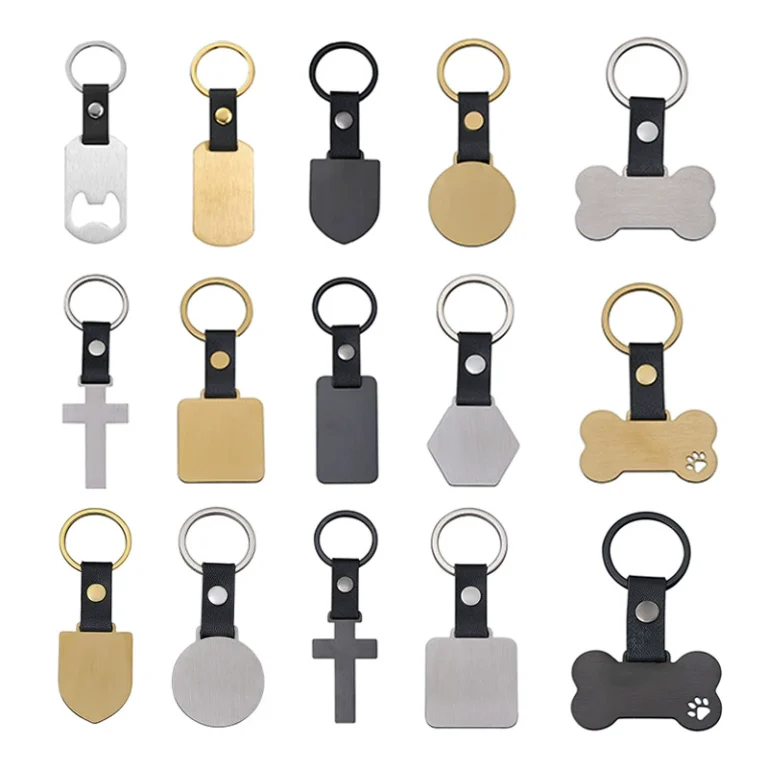
Many buyers searching for fabric keychains actually want a hybrid: a soft woven, embroidered or webbing strap paired with metal hardware or a metal logo plate. The fabric carries color and a full design, while the metal part adds weight, durability and a more premium feel at the point of sale.
- Woven or webbing strap + metal logo plate: a die-cast or stamped metal badge is riveted or sewn onto the strap, so the logo is shown on both materials.
- Fabric tag + metal clasp: lobster clasps, swivel snap hooks or carabiners make the keychain easy to clip onto bags and belt loops.
- Fabric loop + split ring: the simplest and most economical combination for giveaways and events.
- Wristlet style: a longer fabric strap with a metal ring, often used for lanyards, car keys and gym lockers.
When you request a quote for fabric and metal keychains, specify the fabric type (woven, embroidered, printed webbing or felt), strap size, the metal part (plate, clasp or ring), its finish and plating color, and how the two parts are joined. Adding a metal plate usually means separate tooling and more assembly steps than a fabric-only keychain, so confirm the MOQ and lead time with your supplier for the exact combination.
Compare options with our PVC vs acrylic vs metal keychain guide, or browse fabric keychain styles and custom metal keychains.
Frequently Asked Questions
What is the difference between woven and embroidered keychains?
Woven key tags usually have a flatter surface and can suit finer details. Embroidered keychains use raised stitches that create more texture. Artwork size and complexity determine which process reproduces the logo more clearly.
Can fabric keychains have different designs on each side?
Many constructions can use different front and back artwork, but feasibility depends on weaving, embroidery, printing, backing, folding, and assembly. Include both layouts in the RFQ.
Which artwork format should I provide?
Vector artwork is preferred when available. Include exact wording, color references, dimensions, and separate front and back files. The supplier should confirm whether fine details require adjustment.
What hardware can be used with fabric key tags?
Possible attachments include split rings, chains, clasps, hooks, eyelets, and carabiners. The available material, size, finish, and assembly should be confirmed for the project.
How should fabric keychains be packaged for retail?
Options may include individual bags, backing cards, header cards, labels, barcode packaging, boxes, or sets. Choose a format that protects the textile and hardware while meeting retail display and labeling requirements.
What affects the price of custom fabric keychains?
Process, size, colors, artwork detail, edge, backing, hardware, packaging, quantity, sampling, inspection, and shipping requirements can all affect the quotation.