Quick answer
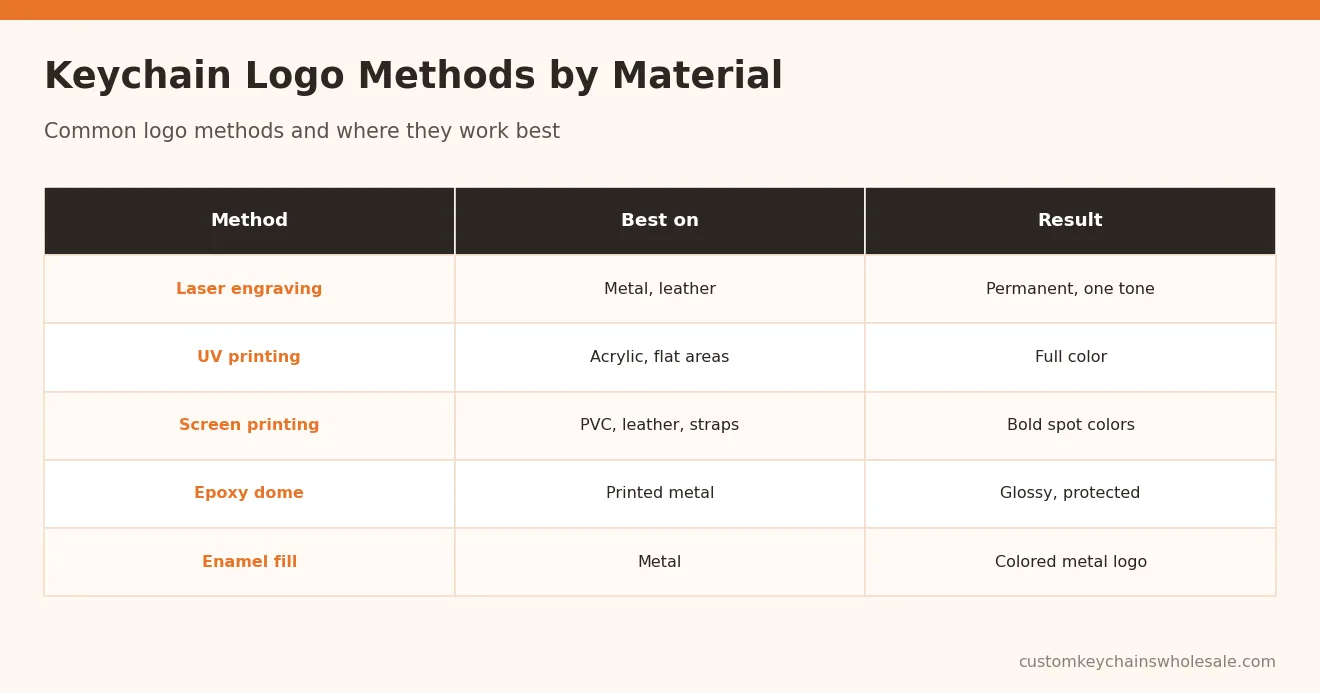
The best keychain logo method depends on material and artwork. Laser engraving gives a permanent, single-tone mark on metal, leather and wood-look surfaces. UV printing handles full-color artwork on acrylic and flat surfaces. Screen printing suits simple spot colors, epoxy dome adds a glossy protective layer, and enamel fill creates colored metal logos.
Choosing among keychain logo methods affects how your brand looks, how long the logo lasts and what the order costs. Laser engraving, UV printing, screen printing, offset printing, epoxy dome and enamel fill each have strengths, and not every method works on every material.
This guide explains each method in plain terms, compares them in a table by material, and gives practical advice on matching your artwork to the right process. It is written for brands, retailers, promotional distributors and online sellers preparing a custom keychain order who want a logo that looks right on the finished product.
Laser Engraving
Laser engraving uses a focused laser to mark or remove a thin layer of material, creating a permanent logo without ink. On metal it produces a clean, tone-on-tone mark; on leather it creates a darker, burned-in effect; on coated metals it reveals the base color beneath.
- Strengths: permanent, crisp, no color fading, suits fine text and serial numbers.
- Limits: one tone only; you cannot choose ink colors.
- Best for: metal, anodised aluminum, leather and premium corporate gifts.
Laser engraving is also a cost-effective way to personalize each piece with names or numbers.
UV Printing
UV printing applies ink that is cured instantly by ultraviolet light. It can print full-color images, gradients and photos directly onto flat or gently curved surfaces.
- Strengths: full color, photo quality, no screens needed, good for many designs in one order.
- Limits: the print sits on the surface, so it can wear with heavy friction unless protected.
- Best for: acrylic, flat metal areas, some PVC and leather surfaces.
UV printing is widely used on acrylic keychains, often printed on the back of clear acrylic so the print is protected. See our custom acrylic keychains for examples.
Screen Printing and Offset Printing
Screen printing
Screen printing pushes ink through a mesh screen, one color at a time. It gives strong, opaque spot colors and suits simple logos with a few colors on flat surfaces such as PVC, leather and fabric straps.
Offset printing
Offset printing transfers a full-color image from plates to the surface. In the keychain world it is often used on printed metal or paper inserts, usually with an epoxy dome on top for protection. It suits detailed, multi-color artwork in larger runs.
Both methods need setup for each design, so they are most efficient when one design is ordered in good quantity.
Epoxy Dome and Enamel Fill
Epoxy dome
Epoxy is a clear resin applied over a printed or enamelled surface. It forms a glossy, slightly domed layer that protects the logo and adds depth. It is often combined with offset printing or soft enamel.
Enamel fill
Enamel fill adds color into recessed areas of a metal keychain, separated by raised metal lines. Soft enamel sits slightly below the metal lines and has a textured feel; hard enamel is polished flat for a smooth, jewelry-like finish. Enamel colors can be matched to Pantone references.
Learn more about metal options on our custom metal keychains page.
Keychain Logo Methods by Material
The table summarises which methods are commonly used on each material. Availability for a specific design should be confirmed in your quote.
| Material | Common logo methods | Best visual result |
|---|---|---|
| Soft PVC | Molded colors, screen print, UV print | Bright 2D or 3D logo built into the shape |
| Metal | Enamel fill, laser engraving, offset print with epoxy | Colored or engraved premium logo |
| Acrylic | UV print, screen print | Full-color artwork, clear or glitter effects |
| Leather | Debossing, laser engraving, screen print | Subtle, premium tone-on-tone |
| Fabric | Woven, embroidery, heat transfer | Textile logo with texture |
| Eco materials | Laser engraving, printing | Natural look with simple logo |
For leather options, see our custom leather keychains.
How to Choose the Right Keychain Logo Method
- Start with your artwork: full-color gradients point to UV or offset printing; simple bold logos suit enamel, screen print or molded PVC.
- Consider durability: engraving and molded colors last longest; surface prints may need epoxy or placement on a protected side.
- Match the brand feel: engraving and debossing look understated; enamel and PVC look bold and colorful.
- Think about quantity and variety: UV printing suits many designs; setup-heavy methods suit fewer designs in larger runs.
- Check color needs: if exact brand colors matter, provide Pantone references.
Our step-by-step guide to customizing keychains with your logo walks through artwork preparation and approval.
Combining Logo Methods on One Keychain
Many of the most effective keychains combine two methods. Using a second method lets you add information or detail without complicating the main logo. Popular combinations include:
- Enamel front, engraved back: a colorful logo on the front and a website, serial number or personal name on the back.
- Molded PVC front, printed back: a 3D character on the front with a small printed logo or message behind.
- UV print plus epoxy: full-color artwork with a glossy protective layer.
- Debossed leather plus metal plate: a subtle leather logo with an engraved metal tag for contrast.
- Woven strap plus metal charm: a textile brand pattern with a premium metal logo piece.
Two-sided and multi-method designs add steps, so they affect price and sometimes MOQ. They are worth considering for retail and gift products, where perceived value matters, and for promotional items where you want to add contact details without crowding the logo.
Cost Factors for Different Logo Methods
Logo method is one of several price drivers, alongside material, size, mold complexity, color count, packaging and quantity. As a general rule, methods that need screens, plates or molds have more setup, which spreads better over larger quantities, while digital methods such as UV printing and laser engraving handle variety and personalisation more easily.
Adding colors, epoxy layers or two-sided logos usually adds steps. The easiest way to compare is to request two logo methods for the same design on one quote.
Get a Quote for Custom Keychain Logo Printing
Not sure which keychain logo method suits your design? Send your logo file, preferred material, size, quantity and packaging needs, and we will recommend the best method for your artwork.
You will receive a free digital mockup and a clear quote. Contact us to start your order. MOQ usually starts from 100 pcs depending on material and design; confirm per quote.
Frequently Asked Questions
Which keychain logo method lasts the longest?
Laser engraving, debossing, enamel fill and colors molded into soft PVC generally last longest because the logo is part of the material rather than ink on the surface. Surface prints such as UV or screen printing can wear with heavy friction, so they are often protected by epoxy or printed on the back of clear acrylic.
What is the difference between laser engraving and UV printing?
Laser engraving marks the material itself with a laser, giving a permanent single-tone logo with no ink. UV printing applies full-color ink that is cured instantly by ultraviolet light, so it can reproduce gradients and photos. Engraving suits metal and leather; UV printing suits acrylic and flat surfaces needing color.
What is an epoxy dome on a keychain?
An epoxy dome is a clear resin layer applied over a printed or enamelled logo. It creates a glossy, slightly raised surface that protects the artwork and adds depth. Epoxy is often used with offset-printed metal keychains and soft enamel designs to improve durability and give a more polished finish.
Can you match my brand colors exactly?
For methods that use ink or enamel, such as screen printing, offset printing and enamel fill, we can work from Pantone references to match your brand colors closely. Molded PVC colors can also be matched to Pantone. Final appearance depends on material and method, so approve a mockup and, for critical colors, a sample.
Which logo method is best for full-color artwork?
UV printing and offset printing are the best options for full-color artwork, gradients and photos. UV printing is especially popular on acrylic keychains, where it can be printed on the back of clear acrylic for protection. Offset printing is often used on metal inserts with an epoxy dome on top.