Custom Name Necklace – Gold Plated Stainless Steel Nameplate
Custom Name Necklace for Women Personalized 18K Gold Plated Letter Chains Customizable Pendant Necklace
Custom metal nameplates wholesale, made factory-direct as logo badges and labels for bags, apparel, furniture, electronics, products and packaging. We produce engraved, embossed, etched and printed nameplates in zinc alloy, aluminium, stainless steel and brass-look finishes, with adhesive, rivet, sew-on or screw fixing.MOQ starts from 100 pcs for selected styles, and we send a free digital mockup before production so you can check size, finish and logo detail. For metal processes and plating options, visit our custom metal keychains manufacturer page.
Showing the single result
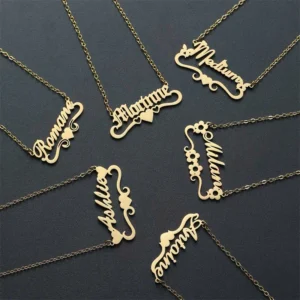
Custom Name Necklace for Women Personalized 18K Gold Plated Letter Chains Customizable Pendant Necklace
A metal nameplate is a small branded badge fixed to a product, bag or package. It adds a premium, finished look and makes your logo easy to recognise. The best style depends on the surface, the level of detail and your budget.
| Style | Best for | Logo method | Relative cost |
|---|---|---|---|
| Die-cast zinc alloy (raised logo) | Bags, leather goods, premium products | 3D die-cast relief with plating | Medium–high |
| Embossed / debossed aluminium | Furniture, appliances, equipment | Stamped raised or recessed logo | Low–medium |
| Etched stainless steel | Machinery, outdoor items, long-life labels | Chemical etching with colour fill | Medium |
| Laser-engraved metal | Serial numbers, small runs, fine text | Laser engraving | Low–medium |
| Printed metal with epoxy | Colourful logos, packaging, gift boxes | Printing with optional epoxy dome | Low |
Relative cost is a guide only. The final unit price depends on material, size, thickness, process, number of colours, plating finish, fixing method and order quantity. Die-cast plates need a mold, which is a one-time cost for each design and is kept for repeat orders.
If you are building a private label range, our private label manufacturing guide explains how branded hardware, keychains and packaging work together.
Artwork should be prepared in vector format, with clear minimum line widths for engraving and etching. If you plan to use the same logo on several products, a consistent nameplate design in two or three sizes can keep your brand look uniform while fitting different surfaces.
Nameplates are usually bulk-packed to protect the finish, with options for OPP bags, protective film and carton marks for your production line. Die-cast molds are kept for repeat orders. Read how to customize with your logo for artwork preparation tips.
Metal nameplates are used as logo badges on handbags, backpacks and luggage, labels on jackets and caps, brand plates on furniture and home products, equipment and machinery labels, and premium details on gift boxes and packaging. A consistent metal logo across products helps customers recognise your brand.
Nameplates can also be combined with keychains, for example a matching logo plate on a leather or fabric keychain, so buyers see the same brand mark on the product and on the gift that comes with it.
Common options include adhesive backing for boxes and smooth surfaces, rivets or pins for bags and leather goods, screws for furniture and equipment, and sew-on holes for apparel. The best method depends on the surface and how much wear the product gets. Tell us where the nameplate will go and we will recommend a fixing.
Engraving cuts the logo into the surface with a laser, which suits fine text. Embossing stamps a raised logo, while debossing presses it in. Etching uses a chemical process to create recessed areas, often filled with colour. Each gives a different look and cost, so we can compare options in your quotation.
Yes. Nameplates can be cut or die-cast into custom shapes, and colour can be added with enamel fill, printing or coloured plating. Finishes such as brushed, mirror, matte and antique are also available. We show the shape, colours and finish on a free digital mockup before production.
WhatsApp us