Quick answer
2D PVC keychains are built from flat raised layers, which suits logos, text and simple characters at a lower tooling cost. 3D PVC keychains are sculpted with rounded, lifelike forms, which suits mascots, figures and premium merch but needs a more complex mold. Choose 3D when shape and feel drive sales.
Buyers ordering soft PVC often ask whether they really need the 3D version, or whether 2D is good enough. Some were disappointed when a 2D keychain looked flatter than the character in their head; others paid extra for 3D on a simple logo where nobody noticed the difference.
This guide compares 2D vs 3D PVC keychains on how they are made, the level of detail, mold complexity, colour count and cost drivers. It also covers the trade-offs and the use cases where 3D is clearly worth it, so you can choose with confidence and brief your supplier accurately.
2D vs 3D PVC Keychains
How layered and sculpted PVC differ in look, tooling and best use
2D PVC
- Flat raised layers
- Crisp logos and text
- Simpler mold
3D PVC
- Sculpted curves
- Lifelike characters
- Complex mold
Cost drivers
- Mold complexity
- Colour count
- Size and thickness
Choose 3D when
- Shape drives sales
- Mascot or replica
- Premium merch
What 2D and 3D Mean for PVC Keychains
Both types are made from soft PVC poured into a mold and cured. The difference is in the shape of the mold.
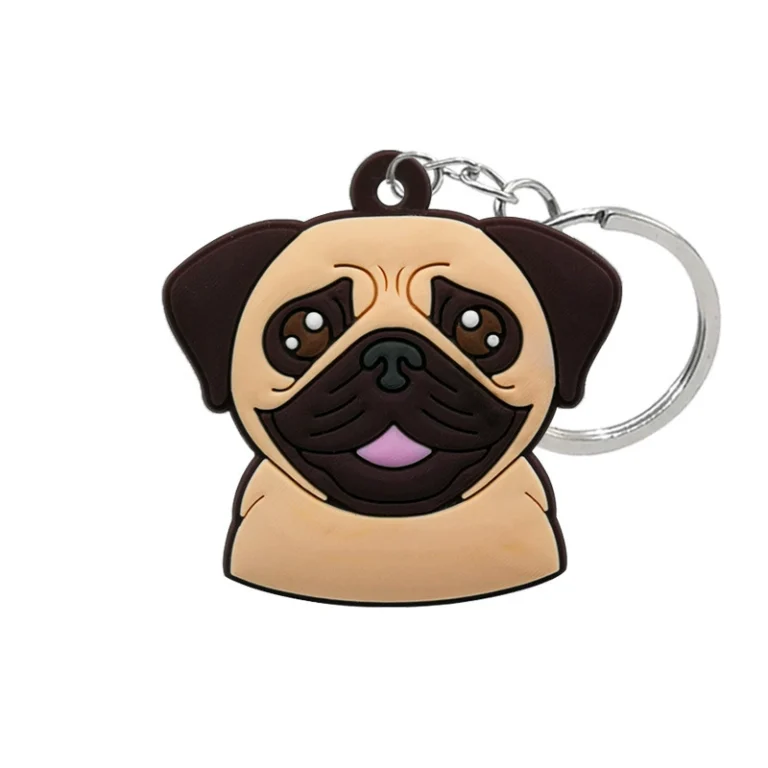
A 2D PVC keychain is made of flat layers stacked at different heights. Each colour area is flat on top, with raised edges and lines separating colours. Think of it like a cut-paper design with depth. A 3D PVC keychain is sculpted: surfaces curve and round off, so a face has cheeks, a car has a rounded body and a shoe has real contours. It can be one-sided with a flat back or fully sculpted on both sides.
See our custom PVC keychains page for the wider range of shapes and finishes.
2D vs 3D PVC Keychains Compared
| Factor | 2D PVC | 3D PVC |
|---|---|---|
| Shape | Flat layers at set heights | Sculpted, rounded surfaces |
| Best for | Logos, text, simple icons | Characters, mascots, products |
| Mold | Simpler engraving | Sculpting and deeper machining |
| Text clarity | Very good on flat areas | Harder on curved areas |
| Thickness | Usually slimmer | Usually thicker and heavier |
| Relative cost | Usually lower | Usually higher |
The gap in cost is mostly in tooling. On large quantities, the difference per piece can narrow.
Detail and Text: Where Each Type Shines
2D PVC handles text, logos and clean graphic shapes well, because each element sits on a flat surface with crisp raised edges. Small text is still a challenge, so keep letters bold and avoid very thin strokes.
3D PVC excels at form: faces, animals, food, vehicles and anything that people want to touch and turn over. It is less suited to small text, since lettering on a curved surface can distort or lose sharpness. A common solution is to keep the 3D shape for the figure and add a flat 2D panel or the back side for the brand name.
Mold Complexity and Why 3D Costs More
Both types need a mold, which is usually a one-time cost per design and size and is kept for reorders. A 2D mold is engraved in steps, one level per layer. A 3D mold has to be sculpted to follow curves, often from a digital model, then machined and checked, which takes more time and skill.
Factors that raise 3D tooling further:
- Fully sculpted two-sided designs rather than a flat back.
- Deep undercuts, thin limbs or small protruding parts.
- Large overall size or thickness.
- Many small colour areas on curved surfaces.
For a full picture of what drives unit price and tooling, see our bulk cost guide.
Planning a custom keychain order? Get an accurate quote
Send these details and we reply with a free digital mockup and a written quote:
- Logo or artwork file (vector AI, PDF or SVG preferred)
- Material and approximate size
- Quantity per design and attachment type
- Packaging, destination country and target in-hand date
Colour Count and Finishing
On both types, each colour is filled separately, so colour count affects unit price and production time. 2D designs separate colours with raised lines, which makes colour placement precise and predictable. On 3D shapes, colours are often painted or filled over curves, so very fine colour details such as eyes, small patterns or gradients may need simplifying or a printed detail.
Send Pantone references for key colours, and mark which colours matter most to your brand. If budget is tight, reducing colours often saves more than switching from 3D back to 2D, while keeping the shape that makes the design appealing.
When 3D Is Worth It, and When It Is Not
3D usually pays off when the shape itself is the selling point:
- Mascots and original characters sold as retail merch or collectibles.
- Product replicas, such as a miniature shoe, bottle or vehicle for a brand.
- Premium gifts where weight and feel signal quality.
- Sports team mascots; see our sports keychains for ideas.
2D is usually the better choice for logo-led promotional giveaways, event keychains, text-heavy designs, tight budgets and large ranges with many designs, where tooling for each design adds up. Always use original or licensed artwork; do not copy existing characters or brands.
How to Decide: A Simple Checklist
Ask yourself these questions before you request a quote:
- Will buyers choose this keychain for its shape, or for the logo on it?
- Does the design rely on small text that must stay sharp?
- How many designs are in the range, and how many pieces of each?
- Is this a one-off promotion or a product you plan to reorder?
- Do you have a digital model or clear front, side and back views for 3D?
If the answers point both ways, ask for a quote on each option. MOQ usually starts from 100 pcs depending on material and design. Browse examples in our PVC keychain category.
Common 2D and 3D PVC Problems to Avoid
Most disappointment with PVC keychains comes from expectations that were never written down. Watch for these issues and address them at the mockup stage:
- A 2D keychain that looks too flat: if depth matters, ask for more layer heights or consider a partial 3D element.
- A 3D face that looks different from the drawing: provide side and back views so the sculptor does not have to guess proportions.
- Colour bleeding between areas: usually caused by colour zones that are too small or lines that are too thin.
- Visible mold lines or rough edges: ask how edges are trimmed and checked before packing.
For complex 3D designs, a physical sample before bulk production is often worth the extra time, because shape and feel are hard to judge from images alone.
Get a Quote for 2D or 3D PVC Keychains
To get an accurate quote and a mockup that matches your vision, include:
- Logo or artwork file, vector AI, PDF or SVG if possible
- For 3D: front, side and back views or a reference model
- 2D, 3D or both options quoted side by side
- Approximate size and whether one-sided or two-sided
- Colours with Pantone references
- Attachment: ring, clasp, chain or strap
- Quantity per design, packaging, destination country and target in-hand date
We send a free digital mockup before production so you can check shape and colours before the mold is made. Send your design for a PVC keychain quote.
Frequently Asked Questions
Is a 3D PVC keychain always thicker than a 2D one?
Usually, because sculpted shapes need depth to show curves, so 3D keychains tend to be thicker and heavier. The exact thickness depends on the design and size. If weight or pocket comfort matters, state a maximum thickness in your inquiry and ask the supplier to confirm it in the mockup.
Can I combine 2D and 3D in one keychain?
Often yes. A common approach is a sculpted 3D figure on the front with a flat back carrying a logo or text, or a 3D element set onto a flat 2D base. This keeps text clear while giving the design depth. Ask the supplier to check feasibility for your specific artwork.
Do 2D and 3D PVC keychains need different molds?
Yes. Each design needs its own mold, and a 3D mold is sculpted while a 2D mold is engraved in flat layers. Both are usually a one-time tooling cost per design and size. We keep molds for repeat orders, so reorders of the same design do not need new tooling.
What artwork do I need for a 3D PVC keychain?
At minimum, clear drawings from the front, side and back, plus colour references. A 3D digital model is even better if you have one. Without enough views, the sculptor has to guess depth and proportions, which can lead to extra proof rounds or a result that does not match your expectations.
Which is more durable, 2D or 3D PVC?
Both are made from flexible soft PVC and handle everyday use well. 3D designs with thin protruding parts, such as ears, tails or limbs, can be more vulnerable to bending or tearing. Keeping thin parts reasonably thick and close to the body improves durability, and the supplier can suggest adjustments in the mockup.
Get a Wholesale Quote for Custom Keychains
MOQ from 100 pcs per design. Samples in 3–7 days, bulk production in 7–15 days. Send your logo or idea and quantity, and we will reply with a quote.